
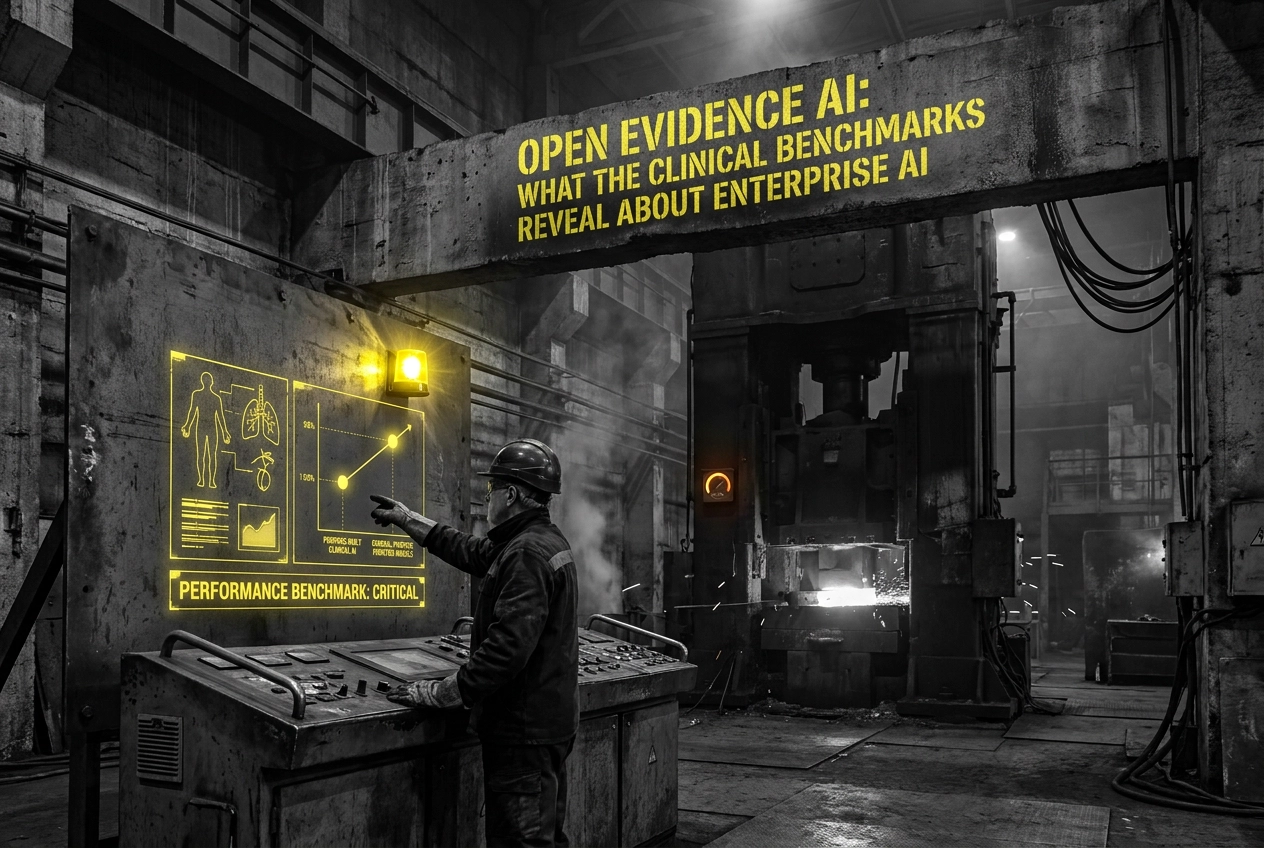
When a medical AI platform consistently outperforms physicians on clinical reasoning benchmarks, the implications extend far beyond healthcare. Open Evidence AI has quietly become one of the most rigorously tested enterprise AI systems in production today, and the numbers demand serious attention from anyone making decisions about AI deployment at scale.
This analysis cuts through the marketing narrative to examine what the clinical benchmark data actually reveals. We will explore how Open Evidence AI performs across standardized medical examinations, diagnostic accuracy assessments, and evidence synthesis tasks, then translate those findings into broader lessons about enterprise AI evaluation methodology. Understanding where this platform excels, and critically, where its performance characteristics plateau, offers a precise lens for evaluating AI systems in high-stakes professional environments.
For technical leaders, AI architects, and enterprise decision-makers, benchmark literacy has become a core competency. The Open Evidence AI case study provides an unusually transparent dataset to work with. By the end of this analysis, you will have a structured framework for interpreting clinical AI performance metrics and applying those standards to your own AI procurement and deployment criteria.
What OpenEvidence Is and How It Was Built
OpenEvidence launched in 2023 out of Cambridge, MA, founded by Dr. Daniel Nadler, who previously built Kensho, an early AI platform for financial intelligence. The capital stack behind OpenEvidence reads less like a typical Series A and more like a coordinated institutional bet: Sequoia Capital led the Series A, Google Ventures and Kleiner Perkins co-led the Series B, and the investor roster expanded to include Nvidia, Blackstone, Goldman Sachs, Mayo Clinic, and Memorial Sloan Kettering. Strategic participation from two of the most rigorous clinical institutions in the country signals something beyond financial conviction. It reflects domain-level endorsement from organizations with direct exposure to the problem OpenEvidence was built to solve. By early 2026, the company had completed a Series D at a $12 billion valuation, bringing total funding to nearly $700 million.
Architecture Built Around Data Access, Not Just Model Performance
The core technical architecture is Retrieval-Augmented Generation applied to a curated, proprietary corpus. Rather than relying on a single general-purpose large language model, OpenEvidence deploys an ensemble of specialized AI models trained exclusively on peer-reviewed medical literature spanning approximately 35 million publications. The structural moat is not the model itself; it is the data access layer. Signed content agreements with NEJM, JAMA, Nature, NCCN, and Cochrane give the platform licensed retrieval rights over the highest-authority sources in clinical medicine. When evidence is inconclusive, the system withholds an answer rather than generating a response, a deliberate design choice to reduce hallucination risk in high-stakes clinical contexts. Every output includes direct citations, enabling physician verification at the point of use. As described in Sequoia’s coverage of Daniel Nadler, the architecture was explicitly designed to prioritize reliability over completeness.
Access Model as Adoption Infrastructure
HIPAA compliance and free verified access are not merely positioning choices; they function as an integrated trust and adoption architecture. By gating access to confirmed U.S. healthcare professionals and eliminating cost as a barrier, OpenEvidence bypassed traditional hospital procurement cycles entirely. The result was organic, word-of-mouth growth at a scale rarely seen in clinical software. As documented in published clinical research on the platform, OpenEvidence now supports millions of physician consultations monthly across more than 10,000 hospitals and medical centers nationwide.
The platform’s scope has expanded well beyond clinical Q&A. Current capabilities include visit note creation, billing code generation, after-visit summaries, scheduling, a voice mode, a dialer with fax and messaging functionality, and CME credit generation. In July 2025, OpenEvidence released DeepConsult, described as the first AI agent purpose-built for physicians. The simultaneous launch of a hands-free voice AI feature and a Cedars-Sinai institutional partnership signals a deliberate move toward ambient AI deployment in high-acuity environments, where screen-based interaction is impractical and documentation burden is highest.
Market Adoption and the Scale of Clinical Penetration
With 757,000+ verified U.S. physicians on the platform as of early 2026, OpenEvidence holds a position that no clinical AI platform has yet come close to matching. The verification requirement is what makes this number structurally significant. These are not passive email sign-ups or trial accounts. Each user has passed identity confirmation as a licensed clinician, which means the adoption signal carries considerably more weight than standard SaaS growth metrics. An independent survey of 1,000+ physicians across 106 specialties found that 45% of reported AI usage pointed to OpenEvidence specifically, and more than 40% of U.S. physicians log in daily across 10,000+ hospitals and medical centers. Monthly clinical consultations climbed from approximately 3 million in early 2025 to over 20 million by January 2026, with a single-day peak exceeding 900,000. These are not vanity figures.
The transition from individual clinician tool to institutional infrastructure is already underway. The February 2026 collaboration with Sutter Health to integrate OpenEvidence within Epic’s EHR environment is the clearest evidence of this shift. When a platform moves inside the charting workflow, it stops being a supplemental resource and becomes embedded operational infrastructure. That transition carries meaningful consequences for procurement, IT governance, security review, and ongoing support obligations. Health system buyers face a different contract surface than individual sign-ups, and the company’s ability to execute that migration cleanly will determine whether the enterprise revenue model materializes at the projected 5 to 10x increase over the current ad-supported baseline.
The free access model was never incidental. It follows a consumerization-then-enterprise pattern that has proven effective across professional software markets: build deep habitual usage at the individual level, then institutionalize through organizational contracts once dependency is established. OpenEvidence’s strategic outlook for 2026 reflects exactly this sequencing. The pharmaceutical advertising model, which currently commands CPMs of $70 to $150 given direct access to roughly 600,000 U.S. prescribers, funds free access while the enterprise pipeline builds. The platform reached $100 million in annual revenue by January 2026, growing from an estimated $7.9 million annualized just over a year prior.
Investor composition adds a layer of strategic insulation that purely technical competitors cannot quickly replicate. The January 2026 Series D closed at a $12 billion valuation with backing from Sequoia, Google Ventures, Kleiner Perkins, Nvidia, Blackstone, Andreessen Horowitz, Goldman Sachs, and critically, Mayo Clinic and Memorial Sloan Kettering. Clinical institution investors provide something that financial capital alone cannot purchase: domain legitimacy and embedded distribution credibility within health system procurement conversations. That investor architecture also funds the data flywheel. At 20 million monthly clinical consultations, query volume at this scale theoretically enables continuous refinement of retrieval relevance across the proprietary corpus, compounding the advantage of the signed content architecture over time in ways that newer entrants, regardless of funding, cannot shortcut.
The July 2026 Nature Medicine Benchmark: What the Data Actually Shows
The July 2026 Nature Medicine benchmark was structured to resist the single-test gaming problem that has undermined prior AI medical evaluations. By combining 500 MedQA questions, 500 HealthBench items, and 100 real clinical queries reviewed by 12 blinded clinicians, the study created a three-layer evaluation that separated standardized knowledge retrieval from the messier, higher-stakes work of applied clinical reasoning. That multi-benchmark architecture matters because any model trained extensively on published medical literature can overfit to question formats. The real clinical query component was designed specifically to surface performance characteristics that written benchmarks tend to obscure.
On MedQA accuracy, the rankings were unambiguous. Gemini 3.1 Pro scored 97.4% (95% CI: 95.6–98.5%), GPT-5.2 scored 94.2% (95% CI: 91.8–95.9%), and Claude Opus 4.6 scored 90.2% (95% CI: 87.3–92.5%). OpenEvidence came in fourth at 89.6% (95% CI: 86.6–92.0%), with UpToDate Expert AI fifth at 88.4% (95% CI: 85.3–90.9%). General-purpose frontier models occupied every top position. The compressed scoring range between OpenEvidence and UpToDate at the bottom of the table suggests that proprietary clinical training data, while valuable, did not offset the raw reasoning capacity of frontier-scale architectures.
The more consequential finding came from the real clinical query component. On that portion of the benchmark, purpose-built clinical AI tools demonstrated 49 to 87 percent lower odds of receiving a higher clinician rating compared to Gemini 3.1 Pro. That is not a marginal gap. It is the kind of performance differential that fundamentally changes the procurement calculus for any organization deploying AI in a high-stakes workflow. The blinded clinician review methodology makes this particularly difficult to dismiss as benchmark artifact; these were practicing physicians evaluating query responses for actual clinical utility.
The subspecialty performance collapse compounds the concern. Despite a competitive overall benchmark score, OpenEvidence accuracy dropped below 50% on complex subspecialty cases. In any enterprise deployment, edge-case reliability is not an afterthought. Subspecialty scenarios are precisely the queries where physicians are most likely to rely on AI support and where errors carry the highest downstream cost.
Perhaps the most structurally significant finding was that Google Search AI Overview matched or outperformed both OpenEvidence and UpToDate Expert AI on real clinical queries. That result directly challenges the defensibility thesis for purpose-built domain AI. If a general search interface can produce clinician-preferred responses without proprietary clinical data agreements or specialized training pipelines, the value proposition of domain-specific architecture requires much more rigorous justification than adoption numbers alone can provide.
The study’s authors did not leave the governance question implicit. They explicitly called for independent, real-world evaluation before clinical AI tools enter institutional settings, a recommendation that aligns with emerging procurement standards across regulated industries broadly. For organizations building AI evaluation frameworks, that recommendation is a signal worth operationalizing now rather than after deployment.
Purpose-Built Domain AI vs. Configured Frontier Models: The Core Architecture Debate
The clinical AI market has bifurcated along a clear architectural fault line. On one side: purpose-built domain tools like OpenEvidence and UpToDate Expert AI, built around RAG pipelines retrieval over proprietary, publisher-licensed corpora, with HIPAA compliance and clinical workflow tooling engineered from the ground up. On the other: general-purpose frontier LLMs applied to clinical problems through configuration, compliance layering, and system prompt engineering. For most of 2023 and 2024, the purpose-built thesis held. Frontier models were meaningfully weaker, and the retrieval advantage from curated, high-authority sources was real enough to justify a separate product category.
That thesis now faces direct empirical pressure.
The Inversion the Benchmarks Reveal
OpenEvidence’s foundational argument was that signed content agreements with publishers like NEJM, JAMA, Nature, NCCN, and Cochrane would produce a retrieval quality advantage general models trained on noisier web data could not overcome. In 2023, this was a defensible position. By July 2026, the Nature Medicine benchmark from Vishwanath, Alyakin, Oermann et al. had tested that premise across three evaluation stages and found it no longer holds. Gemini 3.1 Pro achieved 97.4% MedQA accuracy against OpenEvidence’s 89.6%. On real clinical queries reviewed by 12 blinded clinicians, purpose-built tools had 49 to 87% lower odds of receiving a higher rating than Gemini. Google AI Overview, an auto-enabled search layer with no clinical specialization at all, matched both OpenEvidence and UpToDate Expert AI on the real-query benchmark. These are not marginal performance differences. They represent a structural shift in where the performance ceiling now sits.
The picture is not entirely settled. A separate preprint, the Real-POCQi study, using 620 real queries graded by 149 specialty-matched physicians, found OpenEvidence ahead on accuracy, utility, source quality, verifiability, and completeness. Commentary from clinician-researchers on LinkedIn points out that the two studies tested different query populations, different model versions, and different grading panels, meaning neither definitively resolves the architecture debate. What both studies confirm is that independent, transparent evaluation methodology matters enormously, and that benchmark results are sensitive to who submitted the queries and who judged the responses.
The Frontier Model Access Problem
The competitive challenge compounds at the access layer. ChatGPT for Healthcare, launched in January 2026 as a HIPAA-compliant enterprise product, and ChatGPT for Clinicians, launched in April 2026 and free for verified clinicians, directly replicate OpenEvidence’s core access model while running on a model that outperforms it on published benchmarks. The mechanism that made OpenEvidence structurally defensible, free access for verified professionals gated by credential verification, is now table stakes for well-resourced general-purpose platforms. When access parity and benchmark superiority align in the same competing product, the purpose-built value proposition has to rest on something other than performance scores and access convenience.
Where Proprietary Domain AI Remains Defensible
The architectural question worth asking is not which category is categorically superior. It is under what specific conditions a purpose-built domain tool delivers something a well-configured frontier model cannot replicate. Several vectors remain genuinely defensible. Jurisdiction-specific clinical guidelines, local formulary alignment, and regulatory frameworks not represented in general training data give curated RAG pipelines a real advantage that configuration alone cannot close. Proprietary institutional data, whether EHR-integrated or protocol-specific, creates retrieval depth frontier models cannot access without direct integration. Workflow depth, visit note generation, billing code assignment, CME credit logging, voice mode with hands-free interaction, and fax-integrated dialer tools, represents a layer of clinical utility that benchmark accuracy scores do not capture at all.
The structural insight from the 2026 data is precise: RAG over high-authority, proprietary sources remains the correct architecture for domain-specific AI. The problem is that frontier models have become strong enough that retrieval corpus quality and composition now matter more than model specialization itself. The moat, if one exists, is built at the data layer, the workflow layer, and the compliance layer, not at the model layer.
What Every Enterprise AI Implementation Team Should Take from This
The most transferable lesson from the OpenEvidence benchmark data is one that most enterprise AI procurement teams have not yet institutionalized: aggregate accuracy scores are structural averages, and structural averages conceal the failure modes that matter most. OpenEvidence scores 89.6% on MedQA, a number that would satisfy most vendor evaluation checklists. Yet performance collapses below 50% on complex subspecialty cases. The gap between those two numbers is not statistical noise; it is the operational risk that lives in your most consequential queries. This pattern is not specific to clinical AI. Enterprise AI tools across legal, financial, and industrial domains routinely perform well on general, well-represented query types and fail on the domain-specific edge cases that actually drive decisions. If your organization is evaluating AI on standardized benchmark scores without testing against your own query distribution, you are measuring the vendor’s best conditions, not your operational reality.
Test on Your Own Data Before You Commit
The procurement implication is direct. Vendor benchmarks are designed to perform well. The July 2026 Nature Medicine study used 100 de-identified real physician queries reviewed by 12 blinded clinicians, producing 1,800 model-question annotations precisely because standardized test sets do not simulate operational environments. Independent evaluation of this quality is rare in most enterprise procurement cycles, and that gap is where implementation failures originate. Before committing to a purpose-built solution, build an evaluation protocol using your own query distributions, your own edge cases, and blind review from domain practitioners with reputational stakes in accuracy. Treat any vendor benchmark as a ceiling estimate. The actual performance floor in your environment is what determines ROI.
Implementation Quality Is the Variable, Not the Platform Label
The benchmark comparison between frontier models and purpose-built clinical tools surfaces a finding that applies universally across enterprise AI deployment. Gemini 3.1 Pro scored 97.4% on MedQA. GPT-5.2 scored 94.2%. Claude Opus 4.6 scored 90.2%. OpenEvidence scored 89.6%. The performance gap is not a justification for blanket preference of either category. It is evidence that the label “purpose-built” does not guarantee superior domain performance. Two organizations running the same frontier model with different implementation quality will produce meaningfully different results. Data architecture, retrieval design, RAG configuration, prompt engineering, evaluation rigor, and integration depth are the variables that determine outcome. The platform is a starting condition, not a guarantee. Senior-led implementation teams understand this distinction; organizations that treat platform selection as the primary decision are solving the wrong problem.
Compliance Architecture Is a Procurement Accelerant
OpenEvidence’s HIPAA compliance, verified-user gating, and signed content agreements with NEJM, JAMA, and Cochrane are not regulatory overhead. They are trust infrastructure embedded into the product architecture, and that architecture is a primary reason institutional adoption scaled to 757,000 verified physicians. In any regulated vertical, compliance architecture compresses the procurement timeline by eliminating legal friction at the institutional level. When OpenAI entered healthcare in January 2026, it led with HIPAA compliance as a core product feature, not a footnote. The lesson for enterprise AI implementation in finance, industrial operations, or healthcare-adjacent verticals is the same: compliance architecture built into the system from the foundation drives adoption faster than compliance documentation added after deployment.
AI as Workflow Infrastructure, Not a Search Interface
The ambient AI deployment pattern scaling at Cedars-Sinai represents a maturation point that most enterprise organizations have not yet reached. A pragmatic stepped-wedge randomized controlled trial covering 71,000+ clinical notes over 24 weeks found reduced burnout, improved coding accuracy, reduced documentation time, and a Number Needed to Treat of 1.68, meaning ambient AI produced a measurable benefit for at least one in every two practitioners who used it. OpenEvidence’s current product architecture includes voice mode, ambient visit recording, note generation, billing codes, and care team coordination. That is not a search interface; it is workflow infrastructure. Enterprise organizations still deploying AI as a query-response layer are operating one generation behind the deployment curve that clinical institutions have already validated through randomized evidence.
Read the Cap Table as a Due Diligence Signal
Investor composition is a material signal that most enterprise procurement teams underweight. The presence of Mayo Clinic and Memorial Sloan Kettering in OpenEvidence’s capital structure indicates domain validation that financial backers alone cannot provide. When a health system with reputational accountability for clinical outcomes places capital behind a vendor, it signals that the underlying technology has been stress-tested by practitioners who cannot afford to be wrong. This logic transfers directly to any enterprise AI evaluation. When reviewing a vendor’s backer list, distinguish between financial capital chasing a market and domain-expert institutions whose participation signals genuine validation. The composition of the cap table tells you who has actually used the product under operational conditions, and that is a more reliable signal than any benchmark score the vendor publishes.
A Framework for Evaluating Purpose-Built AI Before You Deploy It
The lessons embedded in the OpenEvidence case do not belong exclusively to healthcare procurement teams. They translate directly into any regulated enterprise environment where AI failure carries operational, financial, or compliance consequences. What follows is a five-step evaluation framework built from the patterns this case surfaces.
Step 1: Define Your Edge Cases Before You Define Your Shortlist
Vendor accuracy figures are aggregate statistics. They describe performance across a distribution of queries weighted toward common, well-represented scenarios. Your organization’s risk exposure lives in the tail of that distribution. Before evaluating any purpose-built AI tool, identify the 10 to 20 query types or workflow scenarios where a failure would carry the highest operational or financial cost. These become your primary evaluation benchmarks. OpenEvidence was explicitly engineered around the highest-cost failure scenarios in clinical medicine: drug dosing errors, missed interactions, and outdated treatment protocols. That same specificity of intent should drive your procurement criteria, not the vendor’s published leaderboard position.
Step 2: Test Against Your Own Data, Not Published Benchmarks
Once your edge case library is defined, run controlled head-to-head testing. Compare your shortlisted purpose-built tool against a well-configured frontier model with appropriate compliance layering for your regulatory environment. Apply both to your actual edge case scenarios and evaluate the outputs against domain-expert judgment. The July 2026 Nature Medicine benchmark demonstrated that frontier models outperformed purpose-built clinical tools across all three evaluation structures, including 500 MedQA questions, 500 HealthBench items, and 100 real clinical queries reviewed by 12 blinded clinicians. That result was not predictable from prior marketing materials or vendor-sponsored benchmarks. Your internal test results will frequently diverge from published figures in ways that matter for your specific use case.
Step 3: Audit the Retrieval Architecture With Specificity
For RAG-based systems, the quality, recency, and authority of the retrieval corpus determine output quality more than the underlying model architecture. OpenEvidence’s platform indexes over 35 million peer-reviewed papers across 300-plus medical journals, with formal content agreements covering NEJM, JAMA, Nature, NCCN, Cochrane, and Wiley. That level of source transparency is a reasonable standard to demand from any enterprise AI vendor. Require documentation of what is indexed, how frequently the corpus is updated, and how retrieval relevance is scored and validated. A vendor unable to answer these questions with specificity has not engineered a system you should trust in a high-stakes workflow.
Step 4: Measure Workflow Integration Depth, Not Answer Accuracy Alone
A tool that produces accurate outputs but requires users to exit their existing workflow creates adoption friction that compounds over time. The OpenEvidence platform expanded well beyond Q&A into ambient documentation, a secure patient calling tool, and hands-free voice mode, and is now deployed across more than 10,000 hospitals and medical centers. That expansion reflects a core implementation truth: accuracy advantages erode when the operational cost of accessing them is too high. Evaluate time-to-decision and workflow disruption as primary metrics alongside benchmark scores.
Step 5: Require Independent Evaluation as a Contract Term
The Nature Medicine study’s explicit call for independent real-world evaluation before clinical deployment is a standard that applies across any regulated enterprise AI deployment. Do not accept vendor-provided evaluation mechanisms, including transparency features built into the product itself, as substitutes for independently audited performance data. Build ongoing performance reporting against agreed benchmarks into the procurement contract before deployment begins. This is not a post-launch audit item. It is a structural governance requirement that protects operational continuity and limits liability exposure across the deployment lifecycle.
The ‘Open Evidence’ Principle as an AI Governance Standard
The term “open evidence” extends well beyond the platform that popularized it in clinical AI. As a governance posture, it describes a specific architectural commitment: AI outputs that are transparent, traceable, and anchored to verifiable sources that a qualified human can inspect, challenge, and reference in a regulatory proceeding. That standard is no longer aspirational. Under the EU AI Act, which entered full enforcement for high-risk AI systems in August 2026, organizations face penalties reaching €35 million or 7% of global annual turnover for serious compliance violations. Colorado’s AI Act and California’s generative AI transparency requirements took effect the same year. The governance gap is now a balance sheet exposure.
OpenEvidence’s citation architecture illustrates what the open evidence posture looks like in practice. Every response the platform generates is anchored to signed content agreements with NEJM, JAMA, Nature, NCCN, Cochrane, and other peer-reviewed publishers. That is not a product feature; it is a trust mechanism with direct legal utility. In healthcare, finance, legal, and industrial settings, AI recommendations that influence regulated decisions must be attributable and reviewable after the fact. A physician, underwriter, or compliance officer needs to be able to reconstruct the rationale chain that produced a given output, not merely trust that the model was generally accurate at the time of deployment. Purpose-built tools that hardwire citation infrastructure into their retrieval layer have a structural advantage here over general-purpose models deployed without explicit attribution and logging architecture.
The July 2026 Nature Medicine benchmark is relevant here not only for its results, but for its methodology. Blinded clinician review, a multi-benchmark design spanning 500 MedQA questions, 500 HealthBench items, and 100 real clinical queries, and execution by an independent research institution: that structure is itself a model for what credible AI evaluation looks like at the enterprise level. Most organizations deploying AI into regulated workflows cannot describe an equivalent internal evaluation process. According to IBM’s 2026 data cited in current AI governance frameworks for enterprise environments, only 29% of organizations audit for unsanctioned AI use at all, meaning the majority cannot trace AI involvement in a given decision, let alone evaluate output quality against an independent standard. That is unquantified operational risk, and it is sitting inside production systems right now.
The FDA’s April 2026 warning letter, which cited AI-generated manufacturing records that were never independently verified, makes the liability dimension explicit. As clinical AI governance frameworks continue to evolve, the finding in that case was not that the organization used AI. The finding was that no qualified human could be shown to have stood behind the output. That is the open evidence gap translated into enforcement language.
For enterprise AI governance frameworks in 2026, the operational requirement is straightforward: every AI-assisted decision that affects a regulated process should generate a traceable, citable rationale chain. This means logging architecture that captures which model version produced an output, what source material it retrieved, what confidence thresholds applied, and which human reviewed and approved it before the decision entered a regulated workflow. That is not idealism. It is the minimum infrastructure needed to answer a regulator’s question after something goes wrong.
Where OpenEvidence Goes from Here and What It Signals for Vertical AI
The product pivot OpenEvidence is executing is the correct strategic response to the benchmark pressure documented in the July 2026 Nature Medicine study. Competing on answer accuracy against Gemini 3.1 Pro, which scored 97.4% on MedQA compared to OpenEvidence’s 89.6%, is an unwinnable long-term position. Frontier models will continue improving, and purpose-built tools cannot outpace that trajectory through model iteration alone. The defensible move is workflow integration depth: visit note generation, billing code assistance, CME credit functionality, voice mode, and the Doctor Dialer create operational dependencies that raw answer accuracy cannot replicate. A physician who has embedded OpenEvidence into their documentation workflow, reimbursement process, and patient communication stack is not choosing between two Q&A interfaces. They are evaluating the cost of re-engineering a clinical workflow around a different system, which is a substantially higher barrier to switching.
The Cedars-Sinai institutional partnership signals something more significant than a single enterprise account. It represents a transition in contract architecture. Individual physician subscriptions, even at 757,000 users, carry low switching costs and aggregate slowly into enterprise revenue. Institutional contracts embed the platform into hospital IT infrastructure, credentialing systems, and clinical operations workflows, creating integration dependencies that are expensive to undo. Enterprise health system buyers also operate under procurement cycles and IT governance requirements that favor incumbents with proven institutional deployment records. Each institutional contract OpenEvidence closes raises the practical barrier for displacement, independent of how frontier model accuracy evolves.
The subspecialty accuracy gap is the platform’s most significant unresolved technical liability. Deep Consult accuracy on complex subspecialty scenarios was reported at 41% in a December 2025 preprint; Quick Consult dropped to 34% on comparable cases. Neither figure is clinically acceptable for high-stakes decision support without some form of confidence signaling or escalation mechanism. Closing this gap requires either retrieval architecture refinement targeting subspecialty literature density, continued domain-specific model improvement, or the implementation of human-in-the-loop escalation protocols for low-confidence queries. Based on current public product documentation, none of these escalation mechanisms appear to be part of the core product. That is an architectural gap that institutional buyers, risk management teams, and regulatory bodies will increasingly pressure the platform to address.
The trajectory OpenEvidence is navigating maps directly onto the strategic decision facing purpose-built AI development across every regulated vertical. Legal research tools, financial analysis platforms, industrial diagnostic systems, and clinical AI all face the same fundamental test: can the purpose-built investment be justified by proprietary data density and workflow integration requirements that a configured frontier model cannot replicate? Tools that cannot answer yes to both conditions will face displacement as frontier models add compliance layering and domain configuration options. Those that can will survive as infrastructure, not as tools, because the switching cost calculus shifts in their favor.
For enterprise operators outside healthcare, the OpenEvidence case is a concrete leading indicator. The strategic question is not whether purpose-built AI outperforms a frontier model on a benchmark. It is whether the business domain contains proprietary data that cannot be licensed or replicated by frontier model providers, and whether the workflows requiring AI integration are sufficiently specific and operationally embedded that a generic model with domain prompting cannot serve them adequately. Where both conditions hold, the purpose-built investment is defensible. Where only one holds, the case for configuration over construction becomes substantially stronger, and the risk of building a platform that frontier models eventually commoditize is a real operational and capital allocation concern that enterprise leadership should pressure-test before committing.
The Benchmark Is Not the Business Case
OpenEvidence is a well-engineered platform with serious institutional backing and genuine clinical adoption at scale. The July 2026 Nature Medicine benchmark data, however, establishes a durable strategic point: purpose-built domain AI no longer carries an automatic performance advantage over a well-configured frontier model. That finding does not invalidate OpenEvidence as a product. It invalidates the procurement logic that treats platform specialization as a proxy for deployment readiness.
The actionable framework for enterprise AI decision-makers is straightforward. Evaluate on your edge cases, not vendor-selected benchmarks. Audit the data architecture, not just the accuracy headline. Demand workflow integration depth over answer quality scores. Build independent evaluation into the procurement process before contracts are signed, because two peer-reviewed studies on the same platform produced opposite conclusions in the same quarter. That divergence is itself the clearest argument for organization-specific validation.
The “open evidence” principle, transparent and citable AI outputs with auditable reasoning chains, is a governance standard worth adopting regardless of which platform sits beneath it. No vendor owns that standard.
Implementation quality is the primary determinant of enterprise AI performance. Organizations that invest in evaluation rigor, integration architecture, and operational alignment will consistently outperform those relying on vendor benchmarks.
This is precisely where Zinnmann Foundry operates. The clinical AI case study is instructive, but the implementation principles transfer directly across every vertical where AI failure carries operational or financial consequence.