
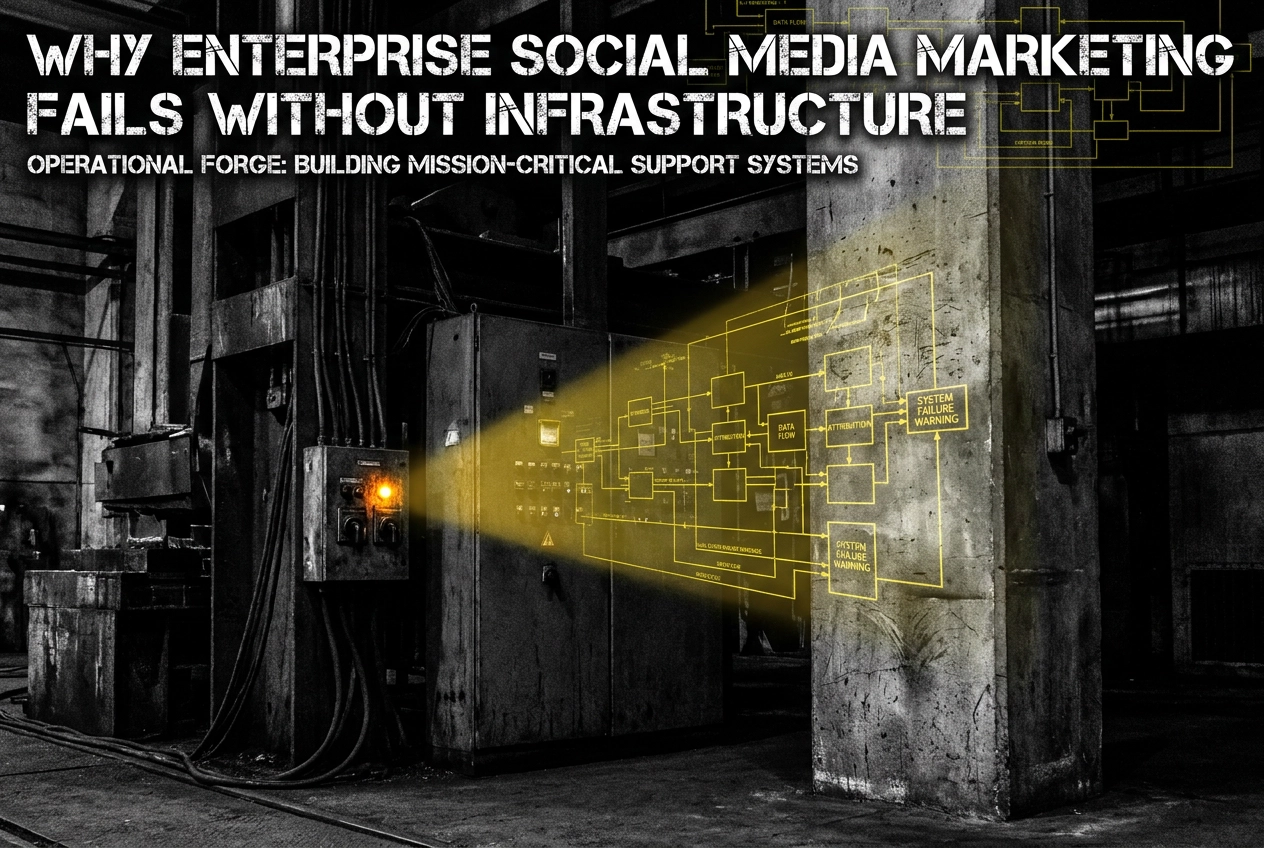
Most enterprise social media marketing programs don’t fail because of bad content. They fail because the infrastructure holding everything together never existed in the first place.
Organizations pour significant budget into creative production, influencer partnerships, and paid amplification, yet they consistently underperform against smaller, more agile competitors. The reason is rarely obvious from the outside, but internal stakeholders often sense it: there is no operational backbone supporting the strategy. No governance framework, no cross-functional alignment, no scalable workflows, and no measurement architecture capable of connecting social activity to business outcomes.
This analysis breaks down the structural deficiencies that quietly erode enterprise social media marketing performance. We will examine why large organizations are uniquely vulnerable to infrastructure gaps, what those gaps look like across technology, talent, and process dimensions, and how the absence of foundational systems compounds over time into measurable competitive disadvantage.
If you are responsible for social media at the enterprise level, or you advise organizations operating at that scale, what follows is a frank assessment of where programs break down and what it actually takes to fix them.
The Performance Gap Is Not a Content Problem
Enterprise social media budgets have grown consistently across B2B organizations, yet pipeline attribution from social channels remains one of the most disputed line items in revenue operations conversations. Finance wants proof. Sales questions the qualified leads. Marketing defends engagement metrics that no one else in the room finds credible. The investment keeps climbing while the measurement infrastructure required to justify it stays largely disconnected from the systems that track actual revenue outcomes.
The default response to underperformance follows a predictable pattern: refresh the creative, increase posting frequency, or shift budget toward whichever platform recently published a favorable case study. These are surface-level adjustments applied to a structural problem. Research into B2B marketing attribution confirms that 79% of MQLs never convert to sales, a figure that has remained broadly flat for three consecutive years. The explanation is not creative fatigue. Programs are being built to optimize for activity rather than pipeline movement, and no amount of content variation corrects that.
The scale of the actual buying process makes this failure more consequential than most teams acknowledge. The average B2B buying journey now spans 272 days across 88 touchpoints, four channels, and ten stakeholders. Critically, 68% of B2B buyers already have a preferred vendor in mind before any tracked touchpoint registers. Social influence shapes decisions long before a form submission or a demo request appears in a CRM record. Treating those touchpoints as brand awareness overhead rather than active decision-stage infrastructure is a costly misclassification.
When social activity cannot be connected to CRM records, opportunity stages, or closed revenue, engagement metrics become a substitute for performance data that simply does not exist. The dark funnel compounds this gap: between 70% and 80% of the B2B buying journey now happens across channels that standard analytics cannot track. Likes and impressions are not evidence of pipeline contribution. They are signals without structural context.
The core problem is architectural. Social media is being managed as an isolated channel rather than engineered as a connected node within a larger revenue system. Fixing revenue attribution requires operational redesign and cross-functional alignment, not another platform purchase or agency retainer. Organizations that close the gap build closed-loop measurement systems connecting social activity to pipeline stages and revenue outcomes across the full buyer journey. Those that do not are allocating significant budget to a program they cannot actually measure.
The 2026 Landscape: What Has Structurally Changed
The numbers confirm what experienced operators have been observing for several quarters: social media marketing is undergoing a structural reconfiguration, not a tactical refresh. AI-powered ad spend is projected to grow 63% in 2026 as organizations formally exit manual campaign management models and consolidate budget inside automated execution platforms. This is not incremental adoption. Brands are reallocating dollars previously absorbed by manual creative production, human campaign management overhead, and fragmented agency retainers into systems that optimize in real time, test creative variants at machine speed, and allocate budget dynamically based on conversion signals.
The automation deployment gap compounds this shift in a meaningful way. Marketing automation platform adoption sits at 68% among B2B teams per G2’s Spring 2026 Report, yet most organizations are extracting a fraction of available value from the AI-powered features embedded in tools they already own. The infrastructure exists inside HubSpot workflows, LinkedIn Campaign Manager’s predictive audience tools, and AI scoring modules inside most modern CRMs. The utilization does not. This represents an organizational readiness problem as much as a technology problem, and it widens the performance gap between teams operating at the ceiling of their systems and those treating enterprise platforms like basic task managers.
Agent-driven buyer behavior introduces a more consequential structural shift for social content strategy specifically. Per 2026 B2B AI marketing research, AI assistants are now actively handling vendor research and comparison shopping on behalf of buyers. Content that is not structured for machine-readable discoverability, answer-formatted retrieval, and AI surfacing will not participate in a growing percentage of B2B evaluation cycles, regardless of engagement metrics. Social content must be engineered for this layer, not just optimized for human scrolling behavior.
The investment trajectory reinforces why this matters beyond the current cycle. The global AI content marketing market is projected to grow from $2.4 billion in 2023 to $17.6 billion by 2033, a trajectory that signals durable infrastructure investment. According to research from the Content Marketing Institute’s 2026 B2B report, B2B marketing strategy is now organizing around connected data, attribution systems, and revenue operations as the defining strategic framework. Organizations still running manual, siloed social programs are not behind on tactics. They are behind on infrastructure, and that is a harder gap to close.
The Infrastructure Gap: Why Enterprise Social Programs Break Down
The most common and most expensive failure in enterprise social programs is not poor creative or inconsistent posting cadence. It is CRM desynchronization: social leads, form fills, and paid ad interactions that generate real intent signals but never propagate into the systems responsible for nurturing, scoring, and converting them. When a decision-maker clicks a LinkedIn lead gen form or interacts with a retargeting sequence, that event needs to travel through a chain of webhooks, API calls, field mappings, and identity resolution logic before it becomes an actionable CRM record. Any break in that chain, whether from a deprecated API endpoint, missing UTM parameters, mismatched field schemas, or ad platform data delays, produces a lead that functionally does not exist. At scale, those gaps compound into significant pipeline leakage that never appears on a dashboard.
Broken attribution pipelines create a second-order problem that often proves more damaging than the data loss itself. As marketing attribution challenges research confirms, enterprise teams frequently reach a point where they stop trusting attribution data entirely, and that institutional loss of confidence has direct budget consequences. Channels that were generating real pipeline activity get cut because the data infrastructure cannot construct a defensible line between social spend and closed revenue. The Association of National Advertisers has documented that roughly 25% of programmatic ad spend is wasted due to misattribution and supply chain inefficiencies, and paid social budgets operate within the same attribution failure modes. The spend continues, but the proof of performance does not.
Siloed channel management compounds both problems. When social media operations run independently from paid search, SEO, and email programs, each channel produces its own reporting layer with its own attribution logic, its own conversion definitions, and its own engagement metrics. The result is conflicting data across teams, duplicated audience spend, and no coherent view of where a buyer actually is in the decision process. As closed-loop attribution frameworks make clear, connecting ad interactions to downstream revenue events requires a unified data architecture, not better coordination between siloed teams running separate tools.
The underlying architectural requirement is middleware: the integration layer connecting social platforms to ERP systems, CRM infrastructure, and analytics pipelines. Without it, the social data stack operates as an isolated reporting environment rather than a connected business intelligence input. The social CRM software market reached $15.8 billion in 2025 and is projected to hit $42.3 billion by 2033, a growth trajectory that reflects how widely this gap is now recognized. Yet market growth confirms the problem is being commercialized, not that it has been solved. Most enterprise teams are still assembling multi-vendor stacks where each integration point introduces a potential failure node.
The pattern, observed consistently across enterprise environments, is that this gap surfaces not during program design but during a failed audit or a budget review that cannot reconcile social spend against closed revenue. By that point, capital has already been misallocated across multiple quarters. As enterprise social reporting frameworks illustrate, properly structured social data infrastructure requires centralized platform data, unified transformation logic, and BI connectivity that routes back into revenue operations. That is not a content strategy problem. It is a systems engineering problem, and it requires architectural intervention before any investment in creative, cadence, or channel expansion produces measurable returns.
Social Media as Operational Architecture: What Connected Infrastructure Looks Like
Connected social infrastructure starts at the data layer. API integrations between social platforms and the CRM are not optional enhancements; they are the foundational plumbing that determines whether your social program can ever be held accountable to revenue outcomes. When a prospect clicks a LinkedIn ad, completes a form, or engages with a retargeting sequence, that event needs to write to a customer record in real time, not through a nightly batch export or a manual CSV import. The integration architecture must account for impression-level data, click attribution, audience segment signals, and conversion events, all flowing into the marketing automation stack with enough fidelity to support downstream scoring and segmentation logic.
Omnichannel Orchestration and the Single Customer Record
True omnichannel execution, as defined in the 2026 implementation framework from Crescent Group, requires that every interaction across every channel contributes to and draws from a unified customer profile. In practice, this means a LinkedIn ad interaction, a retargeting pixel fire on your site, and an email open three days later are all visible within a single record, timestamped, and weighted according to a predefined scoring model. Lead scoring at this level is not built on recency alone. It assigns different weights to social signals versus owned-channel signals based on historical conversion data, recognizing that a paid social click and a direct demo request carry fundamentally different intent signals. Aberdeen Group research cited in the same source found that companies with strong omnichannel strategies retain 89% of their customers, compared to 33% for organizations with fragmented cross-channel integration. That gap is not a content quality problem; it reflects the structural advantage of knowing the full customer journey versus guessing at it.
Attribution Architecture and Real-Time Optimization
Attribution systems must be designed before the first campaign goes live, not retrofitted after quarter-end reporting surfaces unexplained gaps. The pre-launch sequence involves defining touchpoint logic, setting conversion windows appropriate to your sales cycle length, mapping revenue contribution models across the full funnel, and running QA against the data layer before spend is activated. Cross-channel attribution tools are now a mature infrastructure category with dedicated selection criteria, not a reporting afterthought. Benchmarks for functional attribution architecture include 92% identity match accuracy and 90% data unification, metrics that are structurally difficult to achieve when attribution is retrofitted onto existing fragmented stacks.
Real-time optimization pipelines extend this logic into active campaign management. When performance data from social channels connects directly to budget allocation rules, spend can shift toward high-performing audience segments without waiting for a weekly review meeting. Platforms with AI-driven budget management, including automated optimization capabilities now embedded in major paid social environments, reflect this shift in practice. AI-powered ad spend is projected to grow 63% in 2026 as organizations exit manual management workflows, and the operational logic is straightforward: automated pipelines respond to performance signals faster and more consistently than human oversight cycles allow.
Revenue-Tied Reporting as the Operational Standard
Reporting at this infrastructure level has no productive use for reach or impression metrics as primary KPIs. The relevant measurements are social’s contribution to pipeline velocity, which deals in active stages were touched by social interactions, and how those interactions correlate with progression through deal stages and closed revenue. Salesforce data shows that 83% of sales teams using AI reported revenue growth, compared to 66% of teams operating without AI-connected systems, a 17-point gap that reflects the compounding advantage of connected intelligence across the revenue cycle.
Organizations that have fully engineered this layer do not debate whether social media marketing produces returns. They report on it with the same precision applied to any other demand generation channel, because the infrastructure makes that measurement operationally possible rather than analytically speculative.
The AI Integration Layer: Tools Only Perform When Infrastructure Is Ready
Google Performance Max and Meta Advantage+ represent a genuine operational shift in paid social execution. Both platforms now offer near-fully automated campaign management: advertisers supply a business URL, creative assets, and a budget objective, and the AI handles audience targeting, creative testing, bid management, and placement optimization autonomously. Meta is actively rolling out end-to-end Advantage+ campaigns that require minimal manual configuration. Google’s AI Max campaigns have eliminated keyword targeting entirely, using Gemini to match landing page content against user intent signals in real time. AI-powered ad spend is projected to grow 63% in 2026 as organizations exit manual management models. But the performance ceiling for all of these systems is determined by one factor that no platform vendor emphasizes in its sales materials: the quality and completeness of the conversion signals being passed to it from backend infrastructure.
Performance Gains Are Real, But Conditional
The 13% average conversion increase observed by advertisers who added Performance Max to existing campaigns is a frequently cited statistic, and frequently miscited. The lift is real, but it is specifically attributable to advertisers with properly connected conversion tracking and CRM signal passing. Separately, Meta Advantage+ campaign consolidation has delivered up to 32% CPA reduction for advertisers who completed the structural migration correctly. These numbers are not arguments for deploying AI ad tools; they are arguments for building the infrastructure that makes AI ad tools function as designed. Advertisers running these platforms on fragmented attribution stacks, disconnected CRM data, or pixel-only tracking configurations will not see those results. They will generate volume metrics that look acceptable inside the platform dashboard while producing zero qualified pipeline downstream.
The Confident Wrongness Problem
The failure mode is specific and worth understanding in operational terms. Consider a B2B campaign optimized by an AI system receiving only form-fill conversion events as its training signal. The algorithm learns to scale spend toward audiences that generate form submissions. It does this efficiently and at volume. CPL metrics inside the platform improve. The AI is doing exactly what it was trained to do. The problem is that form fills are a proxy for pipeline, not pipeline itself. Without CRM integration, offline conversion data passing, and closed-loop revenue feedback, the system has no mechanism to distinguish qualified from unqualified leads. It scales confidently toward the wrong outcome. This is not a platform failure; it is an infrastructure failure that the platform has no way to detect or correct.
Reviewing the best-practice tracking architectures now recommended for Meta environments makes this explicit: server-side tracking via Conversion API, CRM webhook integration, and multi-touch attribution are now treated as foundational prerequisites for AI optimization, not advanced configurations. The organizations that sequence infrastructure before tooling realize the platform’s performance ceiling. Those that reverse the order produce confidently wrong results at scale.
Where AI Actually Creates Competitive Advantage in B2B
The dominant public conversation about AI in marketing centers on content generation, creative production, and copywriting automation. For B2B organizations operating at scale, that is the least differentiated advantage available. The highest-value AI applications across leading B2B advertising platforms in 2026 center on buyer intent signal processing, account prioritization, predictive pipeline modeling, and real-time spend optimization against revenue targets. This is a meaningful functional distinction. Content generation compresses production cycles; intent-based account prioritization compresses sales cycles and improves close rates. The infrastructure requirements for each are different by an order of magnitude.
The 68% of B2B teams that already have marketing automation platforms deployed are sitting on significant untapped AI capability within systems they already own. Lead scoring models, predictive send-time optimization, and intent-based segmentation features built into platforms like HubSpot and Salesforce-class tools remain dormant when those platforms operate as isolated systems rather than connected layers in a unified data architecture. Extracting that value requires the integration work that connects marketing automation to social channels, CRM records, and analytics infrastructure. The tools are not the bottleneck. The connections between them are.
The infrastructure readiness question must precede the AI tool selection question, not follow it. Organizations that invert this sequence consistently underperform on both fronts: they pay for AI capabilities they cannot fully activate, and they build optimization feedback loops on incomplete data. The procurement pressure runs in the other direction since AI tools generate executive visibility and vendor momentum while infrastructure investment remains architecturally invisible. That asymmetry is precisely why the sequencing error is so common, and so expensive.
AEO, GEO, and Social Content Visibility in the Age of AI Discovery
B2B buyer behavior has crossed a threshold that most social content strategies have not accounted for. In 2026, a growing share of enterprise buyers begin vendor research not with a search engine query, but with a direct question posed to an AI assistant. They ask ChatGPT, Perplexity, or Google AI Mode which solutions are worth evaluating, how approaches differ, and which firms demonstrate credible expertise in a given domain. By the time a prospect visits a vendor’s website, they may have already assembled a silent shortlist built entirely inside AI-generated conversations. That behavioral shift does not just affect SEO strategy; it restructures what social content is supposed to accomplish.
The content that surfaces in AI-generated vendor recommendations is selected by criteria that differ substantially from what drives algorithmic feed performance. Engagement hooks, scroll-stopping headlines, and emotionally-loaded opening lines are optimized for human attention on a platform feed. AI systems are not evaluating that layer. They are scanning for topical authority signals, factual specificity, and structural clarity that allows the content to function as a citable reference. An AI engine parsing LinkedIn for B2B vendor signals will weight a well-structured company article explaining a technical methodology far more heavily than a high-engagement post built around a provocative opinion. The two formats are serving different discovery systems, and most social content strategies are still engineering exclusively for the latter.
Answer Engine Optimization (AEO) and Generative Engine Optimization (GEO) are not replacements for technical SEO; they extend it into a layered visibility architecture. GEO, as the discipline has matured, is understood to be roughly 80% strategic and 20% technical. That framing matters operationally. It means that brand positioning, consistent topical authority across content touchpoints, and the coherence of a firm’s knowledge layer across social, blog, and on-site content are the primary drivers of AI citability, not schema tags alone. Social content, long-form articles, technical documentation, and landing page copy must form a mutually reinforcing reference network that AI systems can navigate with confidence. Fragmented content strategies, where social operates on its own calendar disconnected from SEO architecture and on-site content planning, produce signal inconsistency that degrades AI visibility.
LinkedIn occupies a specific position in this architecture for B2B contexts. Its domain authority within professional subject matter categories, combined with its indexability by major AI systems, makes it one of the higher-weight signal sources for AI-generated vendor research responses. Structured company page content, substantive articles, and posts that provide factual specificity about capabilities and methodology contribute meaningfully to how a firm is surfaced when a buyer asks an AI assistant to recommend vendors in a given category. That is a different content mandate than posting for follower growth or engagement rates.
The organizational implication is significant. Social content strategy can no longer be managed as an isolated function. It requires coordination with technical SEO architecture, schema implementation, and a shared content authority map that spans all publishing channels. Only 16% of brands systematically track their AI search performance today, per McKinsey research. That gap represents a compounding visibility opportunity for organizations willing to engineer their content infrastructure for AI discovery now, while competitors remain focused on feed-level optimization metrics that are increasingly peripheral to how enterprise buyers are actually forming vendor preferences.
The Execution Quality Problem: Senior Strategy vs. Junior Delivery
The structural flaw in the traditional agency model is not a secret. Senior practitioners close enterprise accounts, define strategy, and set expectations during the sales process. Delivery is then handed to junior teams operating standardized playbooks at scale. Fewer than 15% of the 9,000-plus agencies surveyed in the 2026 Experian research demonstrated verifiable platform-specific automation capabilities beyond basic campaign setup. That figure does not represent a talent shortage. It represents a model that was never designed to produce technical depth at the delivery layer.
Enterprise social media programs require operators who can function across two distinct layers simultaneously. The backend layer includes CRM synchronization, attribution architecture, API integrations connecting social platforms to revenue systems, and the data pipelines that make performance visible across the full buying cycle. The growth activation layer includes audience segmentation logic, paid media structure, bid strategy, content positioning, and optimization decisions that compound over time. When these layers are managed by different people with different experience levels and no shared operational context, the program loses coherence. What reaches the client are engagement reports that look acceptable but connect to nothing downstream.
The cost of this disconnect shows up clearly in measurement. Forrester research found that 64% of B2B marketing leaders do not trust their own marketing measurement. That distrust is not accidental. It is the predictable outcome of attribution systems that were never integrated properly in the first place, managed by teams that did not have the infrastructure competency to build them correctly. The result is channel activity generating surface metrics: follower growth, impression volume, engagement rate. None of those figures tell a revenue operations leader whether social is influencing pipeline or accelerating deal velocity.
Sector-specific complexity compounds the problem significantly. Healthcare organizations operating under HIPAA constraints face strict limitations on how patient-adjacent content can be used in retargeting workflows and what data can legally pass between social platforms and CRM systems. Enterprise retail programs must account for seasonal inventory cycles, SKU-level attribution, and multi-location audience segmentation that standardized playbooks are not built to accommodate. Industrial B2B organizations operate with buying cycles measured in quarters, not weeks, and require content strategies aligned to multi-stakeholder decision processes rather than awareness metrics.
The execution gap is not correctable through supervision or training programs layered on top of a flawed structural model. Firms that separate strategic design from operational delivery will consistently produce the same outcome: strategy that was sound on paper and execution that could not carry it forward. Senior-led execution means the operator managing campaign architecture, integration logic, and optimization decisions has built and run these systems at enterprise scale before. Oversight from a senior strategist who reviews reports weekly is not the same thing, and enterprise organizations absorbing the performance gap between those two models are paying a significant price for that distinction.
What a Systems-Engineered Social Media Program Actually Looks Like
A systems-engineered social media program does not begin with a content calendar or a paid media brief. It begins with an infrastructure audit: a structured review of what data is flowing between the CRM, marketing automation platform, analytics stack, and ad platforms, where that data is breaking down, and what integration architecture needs to be in place before any campaign work is justified. This is not a preliminary formality. It is the foundational step that determines whether every downstream activity will produce reliable signal or compound existing measurement failures. Without it, campaign optimization becomes guesswork dressed up in dashboard reporting.
Attribution model design follows directly from the audit findings. This means defining how social touchpoints will be credited across the revenue model, which conversion signals will be passed to ad platforms via server-side event tracking, and how pipeline stage data will flow back into the optimization logic that governs budget allocation. Most enterprise programs skip this step entirely, defaulting to last-touch attribution or platform-native reporting that overstates social’s contribution while obscuring where in the buyer journey social actually drives movement. A properly designed attribution architecture gives revenue operations and marketing leadership a shared, defensible view of social’s role in pipeline development.
Campaign architecture is then constructed on top of that connected infrastructure. Audience segments are built from CRM data and account-level intent signals rather than demographic approximations. Creative is tested against pipeline-qualified behavioral signals, not platform engagement proxies. Budget allocation rules are tied to account-stage progression and deal velocity indicators, not impression volume or follower growth. This approach removes the guesswork that defines platform-native campaign management and replaces it with deterministic logic grounded in revenue data.
AI-powered execution tools are integrated only after backend signals are clean and consistently flowing. With reliable conversion data in place, platforms like Performance Max and Advantage+ can optimize against actual revenue outcomes rather than surface engagement metrics. Advertisers who have implemented this sequence correctly have seen measurable conversion improvements; the infrastructure investment is what makes the AI layer perform as intended rather than amplifying noise.
Reporting is designed around revenue operations metrics from the beginning: social’s contribution to pipeline by stage, cost per qualified opportunity, and influence on deal velocity. Impressions and follower counts are not business metrics. They are platform metrics, and conflating the two is precisely how social media programs lose credibility with CFOs and revenue leadership.
Zinnmann Foundry’s growth engineering model applies this architecture across paid social, organic content, technical SEO, and AEO/GEO systems simultaneously. The firm operates as a senior-led extension of the client’s internal team, not a vendor managing isolated deliverables. Every system is designed to connect, every signal is designed to flow, and every program is built to produce outcomes that hold up in a pipeline review.
Industry-Specific Considerations: Healthcare, Enterprise Retail, and Industrial
Three industries illustrate the infrastructure problem with particular clarity, because each carries operational complexity that generic social media tactics cannot accommodate.
Healthcare operates under a compliance burden that shapes every layer of campaign architecture. HIPAA’s marketing rules govern how protected health information can be used in promotional contexts, and those constraints extend into audience targeting logic, retargeting configurations, pixel implementations, and CRM data flows. The failure mode is predictable: organizations launch campaigns using standard tracking infrastructure, then attempt to retrofit compliance requirements after a legal or privacy review flags the setup. That sequence is backwards. Compliance architecture must be engineered into the system before a single ad impression is served. Platform-level constraints compound this further; Meta’s Special Ad Categories and healthcare-specific advertising restrictions limit targeting options that are standard in other verticals, requiring purpose-built audience strategies rather than adapted general-market approaches. According to MoreVisibility’s Fall 2025 Healthcare Marketing Report, 53% of healthcare marketing leaders identify siloed systems and attribution gaps as actively undermining execution, a problem that compliance complexity intensifies rather than creates independently.
Enterprise retail social media programs face a different but equally structural challenge: maintaining accuracy and relevance at scale across paid and organic channels requires live integration with product feed infrastructure and inventory data. A paid social campaign promoting a product that is out of stock, mispriced, or regionally unavailable does measurable damage to both conversion rates and brand credibility. At SKU volumes typical of enterprise retail, manual oversight is not a viable control mechanism. The data connections between eCommerce systems, product catalogs, and social platforms must be engineered and monitored as operational infrastructure, not managed as a marketing task.
Industrial and B2B manufacturing organizations present a third structural challenge: buying committees that include engineering, procurement, finance, and executive stakeholders, each evaluating the same vendor through different decision criteria. No single value proposition addresses all of them. Account-based social strategies that deliver role-specific messaging across a single target organization are operationally more defensible than individual lead generation campaigns optimized for volume.
The failure mode across all three verticals is consistent. Generic tactics applied to operationally complex environments produce unaccountable results, not because the creative was weak, but because the underlying infrastructure was never built for the sector. Vertical-specific social media strategy is an engineering discipline: it requires the right data connections, compliance guardrails, and attribution logic configured for the specific operational context of each industry.
Building Social Media Infrastructure That Performs at Scale
At enterprise scale, social media marketing is fundamentally a systems engineering discipline. Creative quality and content strategy matter, but they are downstream variables. The upstream determinants of performance are attribution pipeline integrity, CRM synchronization, and the cleanliness of the signals feeding your optimization platforms. Organizations that treat social media as a content operation and ignore the infrastructure beneath it will continue generating activity metrics while pipeline attribution remains unresolved.
Before increasing social spend or deploying additional AI tooling, conduct a structured audit of your attribution architecture and CRM integration. Specifically, test whether social touchpoints are creating traceable CRM records, whether your attribution model accounts for the six to ten touchpoints typical in enterprise buying cycles, and whether privacy-driven signal loss has been addressed through server-side tracking and first-party data strategies. Organizations that have made this transition recover 60 to 75 percent of previously lost conversion signal, a measurable structural advantage over those still running legacy client-side configurations.
AI optimization platforms deliver conversion lift only when they receive clean, connected backend signals. The data is direct: 56 percent of marketing teams now use AI-powered analytics, but only 29 percent can quantify ROI from those tools. The gap is not a technology problem; it is an infrastructure readiness problem. Fragmented data pipelines degrade the inputs that automated platforms depend on for real-time optimization and budget allocation.
For organizations in healthcare, enterprise retail, industrial, and professional services, the path to scalable social performance runs through infrastructure alignment and attribution design. A better content calendar solves none of these problems. Senior operators who understand both backend architecture and growth activation are not a premium add-on for enterprise accounts; they are a structural requirement for producing accountable results.
Zinnmann Foundry works with organizations ready to engineer connected growth systems. If your social program is producing activity but not pipeline clarity, the conversation starts with infrastructure.
Conclusion
Enterprise social media marketing doesn’t fail in the content studio or the campaign brief. It fails in the absence of the systems, processes, and governance structures that allow great work to scale and connect to real business outcomes.
The key takeaways are clear: infrastructure gaps are the primary driver of underperformance, not creative quality. Technology, talent, and process must be aligned before strategy can deliver results. Measurement architecture is non-negotiable if social activity is expected to justify enterprise-level investment.
If your organization is experiencing stagnant performance despite strong creative output, the answer likely lives in your operational foundation, not your content calendar.
Audit your infrastructure before your next campaign. Build the backbone first, and the results will follow. The organizations that commit to this approach don’t just improve their social media performance; they transform it into a genuine competitive advantage.