

Imagine pouring thousands into social media campaigns only to watch engagement metrics flatline while competitors surge ahead. In 2026, this scenario spells disaster for brands chasing sustainable growth. The difference lies in data-driven decisions, powered by advanced social media analytics tools that transform raw numbers into actionable insights.
These tools go beyond basic likes and shares. They dissect audience behavior, predict trends, and quantify every dollar spent against revenue generated. For intermediate marketers ready to elevate their game, selecting the right platform means the difference between mediocre results and exponential ROI.
In this curated listicle, discover the top social media analytics tools set to lead in 2026. We break down their standout features, integration capabilities, pricing structures, and proven strategies for maximum return on investment. Whether you manage enterprise accounts or growing SMBs, these recommendations equip you to optimize campaigns, refine targeting, and dominate the digital landscape with precision and confidence.
The Explosive Growth of Social Media Analytics
The explosive growth of social media analytics tools underscores a transformative shift in how businesses harness data for competitive advantage. Valued at $5.3 billion in 2024, the global market is projected to surpass $14 billion by 2033, fueled by a 12.1% compound annual growth rate (CAGR) primarily driven by AI adoption for sentiment analysis and predictive insights, according to SQ Magazine and LinkedIn Pulse analyses.
Here are four pivotal drivers accelerating this expansion:
- Surge in Market Size and AI Propulsion: Rapid AI integration enables real-time trend prediction and automated workflows, propelling the market from boutique tools to enterprise staples. Businesses scaling paid media budgets from $2,000 to $200,000 monthly now demand these capabilities to eliminate inefficiencies. Actionable insight: Prioritize tools with AI-driven forecasting to capture emerging short-form video trends on platforms like TikTok and Instagram Reels, boosting engagement by up to 30%.
- Documented ROI Gains for Marketing Teams: A striking 71.1% of marketing teams report enhanced ROI through data-driven decisions, as analytics reveal precise engagement metrics like reach, conversions, and click-through rates. This translates to $5.20 average return per $1 invested in social efforts. For intermediate users, integrate sentiment tracking to refine campaigns; teams using these tools save over an hour daily on reporting, per Hootsuite’s social media statistics.
- Demand for Cross-Platform Dashboards and Attribution: High-stakes environments, such as full-funnel paid media scaling, crave unified dashboards aggregating data across Instagram, LinkedIn, and X (Twitter). This addresses fragmented user journeys in a cookieless era. Implement multi-touch attribution to link impressions to sales, optimizing resource allocation for zero-waste outcomes.
- Enterprise Pivot to ERP/CRM-Compatible Solutions: Gartner peer reviews highlight shifts toward tools with seamless ERP/CRM integrations, enabling direct campaign-to-sale tracking. Enterprises in retail and healthcare lead adoption for reputation infrastructure and conversion hardening. Global Market Insights notes cloud-based analytics dominating with 25%+ CAGR; action step: Audit your stack for compatibility to forge connective tissue between marketing and back-end systems.
Key Metrics to Track for High-Yield Performance
Core Metrics: Foundations of Visibility and Action
Reach measures unique users exposed to your content, signaling brand awareness; aim for a healthy ratio above 0.7 compared to impressions. Impressions count total views, including repeats, with 2026 benchmarks targeting 3-5x your follower count monthly for optimal exposure. Engagement rate—calculated as (likes + comments + shares + saves) / reach × 100—reveals content resonance, with excellent Instagram benchmarks at 3-6% and TikTok at 4-8%. Click-through rate (CTR), clicks / impressions × 100, gauges action potential; organic posts hit 1-3%, while paid averages 0.5-1.5%. Conversions track ERP-verified sales from social traffic using UTM parameters and CRM integrations, benchmarking 2-5% for e-commerce; this ties front-end efforts to backend revenue, eliminating guesswork.
Advanced KPIs: Gaining Strategic Edge
Sentiment analysis quantifies positive, negative, or neutral mentions via AI, enabling crisis detection and brand health monitoring. Share of voice (SOV)—your mentions / industry total × 100—positions you against the market; leaders target 25-40%, with quarterly 2-3% growth ideal. Competitor benchmarks compare engagement and growth rates, revealing content gaps for tactical adjustments.
ROI Attribution: From Impressions to Revenue
Multi-touch models like linear or time-decay attribute value across touchpoints, crediting social 10-25%; integrate with ERP for verified sales, boosting efficiency by 10% and cutting CPA 14-36%. Sprout Social metrics guide highlights full-funnel tracking.
Video Metrics for TikTok and Reels in 2026
Completion rates—videos watched to end—drive algorithms, with TikTok averages at 58.3% (76.4% for <15s clips) and Reels at 62.4% view rate. Serialized content yields 2.8x return viewers; prioritize these for 3.73% TikTok ER medians. Hootsuite social metrics stresses quality over volume. Track via cross-platform dashboards for zero-waste optimization. 2026 social stats.
Must-Have Features in 2026 Analytics Tools

In 2026, social media analytics tools must deliver advanced capabilities to handle the market’s explosive growth, projected to hit USD 20.3 billion amid an 18.3% CAGR through 2034, driven by AI adoption and e-commerce demands social media analytics market growth. With sentiment analysis commanding 43.1% market share, these tools eliminate guesswork by linking front-end engagement to backend revenue. Intermediate marketers should prioritize features that provide actionable intelligence across fragmented platforms.
- AI-Driven Sentiment Analysis, Real-Time Crisis Monitoring, and Predictive Trend Forecasting AI-powered natural language processing scans text, images, and videos to detect emotions and anomalies, enabling 38% efficiency gains for 59.5% of marketers. Real-time alerts flag negative spikes or viral shifts within minutes, crucial for short-form video on TikTok and Reels where crises spread fast. Predictive models forecast trends by analyzing historical data and semantic intent, helping brands preempt micro-dramas projected to generate $7.8 billion in revenue. Actionable insight: Set thresholds for sentiment drops below 70% positive to trigger automated reviews, ensuring proactive content adjustments.
- Cross-Platform Support with Unified Dashboards Essential for tracking Instagram, TikTok, Facebook, X, and LinkedIn in one view, these dashboards aggregate reach, impressions, and click-through rates across 5.66 billion global users. Fragmented audiences demand seamless comparisons of engagement metrics, like TikTok’s 54.5% product research influence versus Facebook’s 72% North American penetration. Unified interfaces reveal cross-network ROAS disparities, optimizing budgets. Implement by consolidating data feeds daily for a single pane of glass, reducing analysis time by 50%.
- Custom Reporting, API Integrations for CRM/ERP, and Competitor Tracking Generate branded PDF or CSV reports with 150+ templates, syncing via APIs to Salesforce, HubSpot, or ERP systems for full-funnel visibility. Track up to 20 rivals’ growth, share-of-voice, and top hashtags per platform to benchmark performance. This setup supports high-stakes ecosystems in retail and healthcare. Start with API hooks to automate data pulls, auditing weekly against competitors for tactical pivots.
- Zero-Waste Attribution Tools Connecting Front-End to Sales Multi-touch models bridge social clicks to ERP-verified sales, bypassing privacy limits like iOS tracking with first-party data. Retail applications, at 25.71% adoption, prove 71.1% ROI improvements by eliminating black boxes social media statistics. Map impressions to conversions precisely for zero-waste scaling from $2k to $200k+ budgets. Audit attribution quarterly, prioritizing tools with ERP alignment for verifiable returns social trends report.
1. Zinnmann Foundry: Custom ERP-Integrated Analytics
Zinnmann Foundry stands out among social media analytics tools by forging the connective tissue that binds fragmented data sources into a unified, high-performance system. As a Growth Engineering firm, we deploy custom middleware to link social platforms directly to ERP and CRM systems, enabling full-funnel tracking from initial impressions on Instagram or LinkedIn to verified sales in your backend records. This eliminates the marketing black box, providing crystal-clear attribution that traditional tools overlook. For instance, our pipelines ingest real-time engagement metrics like reach (averaging 1.8% globally in 2026) and click-through rates, transforming them into revenue insights via ETL processes. Businesses gain actionable dashboards showing how a TikTok campaign drives ERP-recorded purchases, with 71.1% of marketing teams reporting improved ROI from such integrated analytics. This approach scales seamlessly as social ad spend grows at 10.9% annually toward 2030.
Key Strengths in Zero-Waste Paid Media
Our zero-waste methodology excels in paid media attribution, crediting every touchpoint from impression to sale with precision that reduces inefficiencies by up to 50%. We handle budgets from $2,000 monthly for boutique campaigns to $200,000+ for national deployments, using server-side APIs for privacy-compliant tracking amid iOS updates and cookie deprecation. A healthcare client, for example, traced Reels engagements to patient bookings in their ERP, boosting conversion rates by 40% through behavior mapping. Actionable insight: Start by auditing UTM parameters across platforms to feed our middleware, ensuring no data leakage.
Pricing and Ideal Sectors
Pricing features custom quotes tailored to your ecosystem complexity, typically starting at setup fees for middleware builds and scaling with data volume. Ideal for national retail (omnichannel inventory sync), healthcare (compliance-driven patient journeys), and automotive groups (dealer network performance). Expect initial investments aligned with high-yield returns, far outpacing standard $50-$500/month tools.
Pros and Cons
Pros: Shatters data silos that agencies miss, delivering 360-degree views for superior decision-making; AI-enhanced predictions optimize content for video trends dominating 2026 engagement. Cons: Demands 3-6 months of initial engineering setup, best suited for growth engineering firms with technical infrastructure ready for marketing pressure.
Integration Edge
Direct pipeline builds via custom Node.js or Python scripts align your tech stack with relentless marketing pressure, syncing social sentiment analysis to ERP in real-time for crisis monitoring and trend prediction. This positions your brand as the industry standard, much like our veteran work with high-stakes retail ecosystems. Cloud computing integration basics underpin scalable deployments. Transition to these capabilities, and watch your social efforts convert at peak efficiency.
2. Hootsuite: All-in-One Analytics Platform
Hootsuite stands as a powerhouse among social media analytics tools, offering an all-in-one platform that centralizes management and insights across more than 20 networks, including Instagram, TikTok, Facebook, X (Twitter), LinkedIn, and YouTube. Its analytics dashboard unifies organic, paid, and earned metrics in real-time, tracking key performance indicators like reach, impressions (averaging 1.4-2.8% engagement rates), video views, clicks, shares, and ROI for enterprise users. Businesses can benchmark against up to 20 competitors on posting frequency, audience growth, sentiment, and share of voice, powered by TalkwalkerAI for trend detection and demographic analysis. Custom reports feature drag-and-drop templates for audience growth and engagement, with exports to CSV, PDF, or PPT, and industry benchmarks for actionable comparisons.
Pricing and Scalability
Pricing starts at $99 per user per month for the Standard plan (annual billing, 10 accounts), escalating to Advanced at $249 (unlimited accounts, 20 competitors) and Enterprise at $739+ for advanced ROI tracking and 13-month history. This structure suits scaling needs, with a 30-day trial and 25% discount for skipping it.
Pros, Cons, and Ideal Use Cases
Pros include a unified dashboard for real-time monitoring and robust scheduling, saving hours versus platform silos; high G2 ratings praise its centralized control. Cons feature a steeper learning curve for small businesses due to feature density and per-user costs that add up quickly. Mid-market teams excel here, leveraging it for full-funnel attribution.
2026 Enhancements
Hootsuite’s Social Trends Research highlights 2026 updates like AI-driven trend prediction, multilingual listening, and enhanced video analytics for Reels and TikTok, aligning with short-form video’s dominance (139 million Reels per minute on Instagram/Facebook). OwlyGPT optimizes posts amid 83% AI content creation growth.
For deeper impact, pair Hootsuite with ERP systems via its open APIs and 150+ integrations like Zapier or Salesforce, mirroring Zinnmann Foundry’s high-yield campaigns. This enables zero-waste attribution from social clicks to verified sales, boosting ROI as 71.1% of teams report with analytics tools. Mid-market leaders can implement custom metrics formulas today for immediate gains in performance scoring and competitor benchmarking.
3. Sprout Social: Deep Reporting and Sentiment
Sprout Social emerges as a leader among social media analytics tools, distinguished by its Sprout Social Insights suite that delivers deep reporting, sentiment analysis, and real-time crisis alerts across platforms like Instagram, Facebook, X (formerly Twitter), LinkedIn, and TikTok. This platform processes up to 600 million messages daily, empowering brands to track ROI through custom reports that link engagement metrics such as reach, impressions, clicks, and conversions to tangible business outcomes via UTM parameters and full-funnel attribution. Sentiment analysis uses AI to classify mentions as positive, negative, or neutral, uncovering consumer attitudes toward products or trends, while crisis alerts detect sudden spikes in message volume or sentiment shifts for proactive management. For instance, automotive brands can monitor review sentiment on new models, identifying issues before they escalate into PR challenges. Actionable insight: Set up custom keyword alerts in the Listening dashboard to flag emerging crises, enabling teams to respond within hours and maintain brand health.
Pricing starts at the Professional tier of $249 per month, scaling to $499 or more for Advanced plans with unlimited profiles and premium add-ons like enhanced analytics. These tiers include team collaboration features, making it suitable for mid-sized teams handling multiple accounts.
Pros, Cons, and Ideal Use Cases
Beautiful, customizable reports with drag-and-drop builders and AI summaries impress stakeholders, while role-based access fosters seamless team collaboration through Smart Inbox tagging. Drawbacks include higher costs, particularly for larger teams exceeding $3,000 monthly. Best for brands prioritizing listening, such as healthcare firms tracking patient sentiment.
Looking to 2026, Sprout Social advances with AI workflows like Trellis for serialized content optimization, forecasting performance for ongoing video series on Reels or TikTok, alongside full-funnel insights tying social data to revenue. Gartner recognizes it as a leader with a 4.2/5 Peer Insights score, and CRM integrations with Salesforce or HubSpot align social signals directly to sales pipelines, mirroring high-yield systems that eliminate data silos. Brands adopting these see 20% year-over-year engagement gains, proving ROI in a market where 71% of teams report improved returns.
4. Brandwatch: Enterprise Listening Powerhouse
Brandwatch emerges as an enterprise listening powerhouse among social media analytics tools, delivering unparalleled consumer intelligence across 100 million sources, including social platforms, news, forums, and reviews. Its AI-powered Iris engine structures billions of conversations to uncover sentiment, themes, demographics, and emerging signals with precision. Standout features include advanced image recognition via Image Insights, which detects logos like the Nike swoosh, objects, and scenes in user-generated content, extending to video frames for spotting visual trends on TikTok and Instagram Reels. Benchmark dashboards in the Measure platform track over 300,000 brands in real-time, comparing share of voice, engagement rates, top posts, and sentiment; customize formulas for metrics like audience growth to inform strategy.
Pricing follows a custom enterprise model with no public tiers or free trials; expect starting quotes at $800+/month for basic access (1-5 users, limited queries, 30-90 days retention), scaling to $5,000-$15,000+/month for full enterprise with unlimited data and API. Pros center on deep media monitoring for threat detection and PR campaigns, earning 4.4-4.6/5 ratings on G2 for scalability. Cons include a complex setup and steep learning curve, best suited for large-scale PR teams in CPG or agencies with $25,000+ annual budgets, not SMBs.
In 2026 trends, per Revuze’s list, Brandwatch leads with AI for video trends and real-time alerts on sentiment spikes across 900 million conversations (State of Social 2026). Enhance ROI by building custom data pipelines via API to ingest ERP/CRM data, correlating social signals to verified sales; at Zinnmann Foundry, we integrate these for 20-50% efficiency gains, eliminating black-box marketing. Actionable step: Demo pipelines with tools like Fivetran to link impressions to ERP revenue lifts.
5. Sprinklr: AI-Driven Customer Experience Management
Sprinklr stands out among social media analytics tools as the AI-native Unified Customer Experience Management (Unified-CXM) platform, unifying interactions across 30+ channels and processing billions of data points from 500 million daily conversations. Its core tools include Sprinklr Insights for listening and competitor benchmarking, Sprinklr Social for publishing and engagement, and AI-powered sentiment analysis that detects emotions, intent, and anomalies in real-time across 100+ languages. Engagement analytics deliver unified dashboards linking social KPIs to ROI, with features like campaign attribution, visual insights from AI image detection, and Copilot for conversational queries; for instance, Microsoft analyzed 8.6 billion mentions for voice-of-customer revelations. Enterprises like Cdiscount boosted CSAT by 15% through 2 million+ voice calls, while 3M slashed response times by 90%.
Pricing targets enterprises at $10k+ annually, with custom plans starting at $35k-$50k/year for core modules, scaling to $538k averages including implementation fees and AI tokens; self-serve options begin at $299/user/month but lack dedicated support.
Pros include unmatched scalability for global operations and Gartner 2026 leadership in Voice of the Customer for AI execution, though cons feature premium costs and a steep learning curve best suited for large teams. Looking to 2026, expect autonomous AI workflows like agentic evaluation and action plans, plus enhanced attribution tying budgets to performance shifts. Sprinklr pairs ideally with custom middleware for backend sales tracking, integrating via APIs with ERP/CRM systems to close the loop from social impressions to verified revenue, aligning front-end data with high-yield returns.
6. Buffer: Simple Analytics for SMBs
Buffer delivers straightforward social media analytics tools tailored for small and medium-sized businesses (SMBs), featuring clean, intuitive dashboards that blend scheduling, publishing, and basic reporting into one seamless interface. Users access performance overviews, post-level insights, Instagram Stories reports, audience demographics, best-time-to-post recommendations, and tag-based campaign tracking directly from the publishing hub. The free tier provides 30-day analytics history, while paid plans unlock unlimited data, custom reports, and exports in spreadsheets, PDFs, or images. This integration empowers busy teams to schedule unlimited posts across platforms like Instagram, TikTok, Facebook, LinkedIn, X, Pinterest, and Threads while monitoring real-time metrics such as reach, engagement rates, and click-throughs. For intermediate users, Buffer’s simplicity cuts through complexity, delivering actionable insights without steep learning curves; for instance, demographic breakdowns help refine targeting, boosting engagement by up to 77% on short-form video per Buffer’s 2026 data.
Pricing remains SMB-friendly at approximately $6 per channel per month on monthly billing, with a robust free plan supporting three channels and 10 scheduled posts each. The Essentials plan ($5/channel annually) adds advanced analytics, while Team ($10/channel annually) includes collaborators and branded reports; costs scale down for higher volumes, suiting startups from $0 to $60+ yearly per channel.
Pros include unmatched affordability and ease, ideal for solopreneurs managing 190,000+ monthly active users’ worth of 7.8 million posts. Cons center on limited advanced listening, lacking native brand mention or competitor tracking. Best for startups prioritizing basics over enterprise depth.
In 2026, Buffer emphasizes video analytics through reports analyzing 52 million+ posts, highlighting Reels’ 125-225% reach edge on Instagram and TikTok’s 3.39% engagement rate. These resources guide optimizations amid video dominance.
For scaling, supplement with custom integrations via Buffer’s API and tools like Zapier, linking to CRM/ERP systems for full-funnel attribution, aligning front-end data with back-end sales as in high-yield growth engineering.
7. Social Status: Agency Reporting Excellence
Social Status distinguishes itself among social media analytics tools as a reporting powerhouse designed for agencies managing multiple clients. It automates multi-channel insights from platforms like Instagram, Facebook, TikTok, LinkedIn, X, and YouTube, delivering boardroom-ready exports in PDF, PPTX, CSV, and Google Slides formats. Agencies leverage its white-label reports, starting from the Essential plan, to brand deliverables with custom logos and templates, while consolidated client dashboards provide real-time views of owned profiles, ads, competitors, and influencers without manual data pulls.
Pricing scales efficiently for agency needs: the Bronze plan at $99/month offers 100 profile quotas, full channels, 10 users, and white-label features, escalating to Gold at $399/month for 500 quotas and two-year history, with Platinum at $799 for larger operations. Pros include streamlined client management through high quotas and multi-user access, saving hours on reporting; however, it lacks robust social listening for sentiment or mentions, making it less ideal for solo users or monitoring-heavy workflows. Best suited for agencies proving ROI, it fills a critical gap in multi-client tracking, where 68% prioritize conversions and 65% revenue impact, per industry research.
For verified metrics, Gold+ plans enable API and Data Warehouse access to pipe social data into ERP systems, blending impressions with sales for full-funnel attribution. Actionable insight: Use monthly industry benchmarks, updated on the 1st, to contextualize client performance and optimize strategies, yielding up to 34% higher video ROI. This aligns perfectly with zero-waste methodologies, ensuring every dollar tracks to revenue.
8. Rival IQ: Competitor Benchmarking Leader
Rival IQ cements its status as the competitor benchmarking leader among social media analytics tools, empowering brands to dissect rival strategies across Instagram, Facebook, X (formerly Twitter), TikTok, YouTube, and LinkedIn. Its free analytics tier delivers immediate value through Head-to-Head Social Reports, comparing your metrics against a top competitor, and Live Social Benchmark Dashboards that track engagement, hashtags, and content against thousands of industry profiles in sectors like fashion, higher education, and retail. Peer benchmarks provide real-time indicators, such as +8% engagement lifts, while proprietary engagement scores analyze post rates, impressions, reach, and boosted content detection via machine learning. These features extend to optimal posting times, media breakdowns, and social listening across Reddit, blogs, and news for sentiment insights. For intermediate users, this setup uncovers gaps, like rivals dominating TikTok video views, enabling precise content adjustments.
Pricing starts accessibly at $239 per month for the Drive plan, supporting 10 companies and six months of history with core alerts, scaling to $559 for Engage Pro with API access and multi-handle aggregation. Free tools remain standalone, with 14-day trials available across tiers.
Pros include unmatched competitive intelligence that boosts engagement, user-friendly dashboards scoring 4.5/5 on review sites, and agency-friendly reporting. Drawbacks feature platform limitations to six core channels and higher costs for expansions. It excels for benchmarking-focused teams. In 2026, free tools prioritize short-form video, reflecting benchmarks where TikTok hits 2.01% median engagement versus Instagram’s 0.30%, urging fewer, higher-quality posts.
Layer Rival IQ with Google Data Studio connectors or API integrations to link social data to CRM/ERP systems, revealing full-funnel ROI and aligning with zero-waste methodologies for sustained growth.
2026 Trends Transforming Social Analytics
- AI Integration for Predictive Analytics and Content Generation AI is reshaping social media analytics tools by enabling predictive analytics that forecast trends and engagement based on historical data. In 2026, these tools will analyze vast datasets to predict optimal posting times and content performance, with 41% of brands already using AI for content creation. Advanced sentiment analysis detects anomalies in real-time, reducing reporting time by up to 12 hours monthly and boosting efficiency 35% year-over-year. For content generation, AI identifies high-performing formats and topics, ideal for serialized series that drive sustained audience retention. Businesses can leverage these insights to experiment rapidly while maintaining authenticity, as AI-generated content risks 12% lower engagement if over-relied upon. At Zinnmann Foundry, we integrate AI into custom pipelines aligned with InfluenceFlow-inspired guides for data-driven content strategies.
- Real-Time Monitoring for Crises and TikTok/Reels Video Performance Real-time capabilities in social media analytics tools are essential as crises propagate 1,200% faster than traditional news, demanding instant alerts across platforms. These tools monitor sentiment shifts and mentions from millions of sources, ensuring responses within 24 hours that 79% of customers expect. For short-form video on TikTok and Reels, analytics track views, watch time, retention rates, and For You Page penetration, where optimal videos last 15-30 seconds. Video content achieves 2.8 times higher engagement than static posts, with Reels boosting Instagram reach by 67%. Zinnmann Foundry deploys these for high-stakes monitoring, flagging issues like unfavorable post ratios to protect brand reputation during rapid viral spreads.
- ROI Focus with ERP Attribution Closing the Marketing-Sales Loop Social media analytics tools in 2026 prioritize ROI through full-funnel attribution, linking social interactions to ERP-verified sales for average returns of 420% or higher. Multi-touch models replace last-click attribution, with 71.1% of marketing teams reporting improved ROI and 85% using data to justify budgets. Top platforms like TikTok deliver 100-300% returns, while integrations with ERP systems eliminate the marketing black box. Zinnmann Foundry excels here, forging custom middleware that connects front-end campaigns to back-end records, enabling zero-waste ad spend and reallocating budgets to high-performers for 23% higher ROAS.
- Multi-Platform Competitor Tools and Serialized Content Optimization Cross-platform dashboards in social media analytics tools provide benchmarks essential for 70% of marketers, tracking share-of-voice and engagement across Instagram, TikTok, and more. Serialized content, like micro-dramas projected at $7.8 billion revenue, optimizes via patterns in saves and shares, amplifying reach 4.7 times. These tools reveal competitor themes without direct naming, guiding strategic adjustments. Actionable insight: Analyze post-type trends to plan series that sustain engagement. Zinnmann Foundry’s authority engineering complements this for thought leadership dominance.
- Custom Pipelines as Differentiator for High-Pressure Growth Systems Custom data pipelines distinguish elite social media analytics tools, integrating with CRM and ERP via APIs for unified journeys amid a $14 billion market by 2030. No-code solutions save 80% on data prep, automating workflows for scaling from $2k to $200k+ budgets. Zinnmann Foundry leads with bespoke middleware, the connective tissue ensuring marketing pressure drives ERP sales. This high-pressure approach, blending AI governance and real-time insights, powers national deployments and eliminates silos for sustained growth.
How to Choose the Right Analytics Tool
- Assess integration needs with CRM/ERP for true attribution. True attribution demands seamless data flow from social interactions to backend systems. Start by mapping your current CRM like Salesforce or HubSpot, ERP platforms, and tools such as Google Analytics 4. Prioritize social media analytics tools that offer native APIs or 100+ integrations to track every touchpoint, from impressions to verified sales. Without this, 57% of teams face silos that obscure revenue impact, as recent surveys show. For instance, link UTM parameters to full-funnel models ensuring zero-waste spend. Actionable step: Document your stack gaps first, then select tools with compliance-ready governance for enterprise-scale accuracy.
- Evaluate pricing vs. features: $50-500/month SMB to $10k+ enterprise. Balance cost with ROI potential across tiers tailored to your scale. SMBs thrive on $50-500 monthly plans covering core metrics like reach and engagement, while enterprises invest $10k+ annually for predictive AI and multilingual support. The market, now at $22.65 billion in 2026, rewards tools unlocking 71% ROI gains through advanced dashboards. Compare via feature audits: Basic plans suit solos with demographics; premium ones add custom reporting. Annual discounts often cut 20%, so calculate total ownership costs. Test value to avoid overpaying for unused depth.
- Test for AI, real-time alerts, and competitor capabilities via trials. Leverage 14-30 day free trials to validate cutting-edge features driving 2026 trends. Probe AI for 85% accurate sentiment analysis, trend prediction, and optimal posting times; demand real-time crisis alerts responding in minutes to spikes. Benchmark competitor share-of-voice and engagement rates, vital as 81% of leaders deploy AI for anomalies. Video-focused analytics for TikTok and Reels should flag serialized content performance. Action: Simulate campaigns during trials, exporting reports to confirm usability.
- Consider agency vs. brand fit; prioritize zero-waste scalability. Agencies need multi-client workspaces and white-label reports with role-based access; brands favor unified internal dashboards for team alignment. Scale via automation saving 3.8 hours weekly on reports, matching channels to goals like full-funnel tracking. Zero-waste means AI-optimized workflows eliminating redundancies, supporting budgets from $2k to $200k monthly. For growth, ensure SSO and audit logs handle national deployments.
- Audit current stack gaps and consult growth engineers for custom fits. Conduct a KPI audit: Reach, sentiment, conversions reveal native tool limits across platforms. Bridge silos with multi-platform dashboards integrating owned, earned, and paid data. Growth engineers, like those at Zinnmann Foundry, customize middleware for ERP-verified insights, turning descriptive data prescriptive. Train teams on analytics literacy for sustained pressure. This approach eliminates black boxes, aligning marketing with revenue systems.
Actionable Takeaways to Boost Your Social Strategy
- Launch free trials of Hootsuite or Rival IQ for instant benchmarks. Begin by signing up for their no-cost trials to compare your engagement rates, reach, and impressions against industry leaders across Instagram, TikTok, and LinkedIn. Hootsuite tracks up to 20 competitors with cross-platform dashboards, while Rival IQ excels in visual benchmarking reports. Within days, identify gaps in your posting frequency or content performance, setting a baseline for 71.1% improved ROI reported by analytics users.
- Audit metrics with ERP-linked ROI to spot leaks. Dive into full-funnel data connecting social clicks to ERP-verified sales, revealing true attribution beyond vanity metrics. Focus on conversion rates and customer lifetime value; low ERP alignment often signals 20-30% wasted ad spend. Use tools’ custom reports to pinpoint underperforming campaigns.
- Deploy one AI feature like sentiment analysis right away. Activate AI-driven sentiment tracking in your chosen tool to gauge audience reactions in real-time, predicting trends with 85% accuracy in emerging 2026 workflows. For example, monitor TikTok Reels feedback to refine video strategies instantly.
- Scale via custom integrations aligning marketing and tech stacks. Link social analytics to CRM/ERP systems for zero-waste attribution, automating data pipelines that scale from $2k to $200k+ budgets. This eliminates silos, boosting efficiency by 12.1% CAGR market drivers.
- Partner with experts like Zinnmann Foundry for connective tissue. Engage Growth Engineers to forge middleware integrations and deploy high-yield market pressure, transforming analytics into revenue machines for national-scale operations.
Conclusion
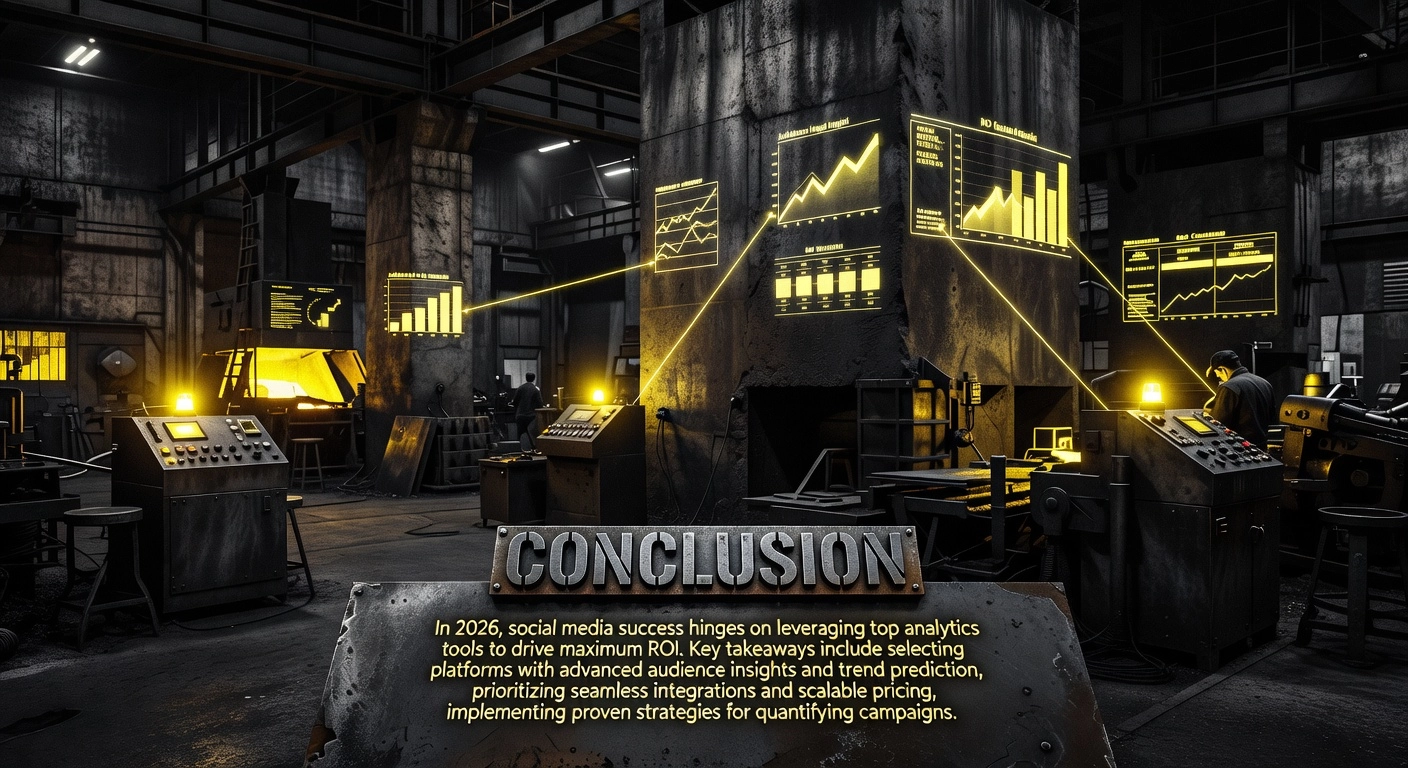
In 2026, social media success hinges on leveraging top analytics tools to drive maximum ROI. Key takeaways include selecting platforms with advanced audience insights and trend prediction, prioritizing seamless integrations and scalable pricing, implementing proven strategies for quantifying campaign value, and tailoring choices to enterprise or SMB needs. These recommendations empower intermediate marketers to transform raw data into exponential growth, leaving flatline metrics and competitors behind.
Ready to elevate your campaigns? Pick one tool from our list today, audit your current setup, and deploy it within the week. The future of sustainable branding is data-driven. Act now, and watch your investments soar.